On people
Managing Is Not the Same as Transmitting
June 16, 2026 · 7 min read
The wrong map
At some point, almost every founder or first-time manager encounters a version of this moment. Someone on their team, a junior hire, an intern, a first employee, is quietly struggling. Not with the tasks. With something harder to name. They don't know if they're doing enough. They don't know what good looks like here. They don't know how to measure a workday when no one has defined what the workday is for.
And so they do what any reasonable person does when they're lost. They borrow a map.
They ask a friend who works in corporate. They look at how other startups operate. They compare their role to job descriptions they find online. They piece together a reference point from whatever is nearby, because the person who was supposed to give them one hasn't done it yet.
That person is usually you.
I know because I was that person.
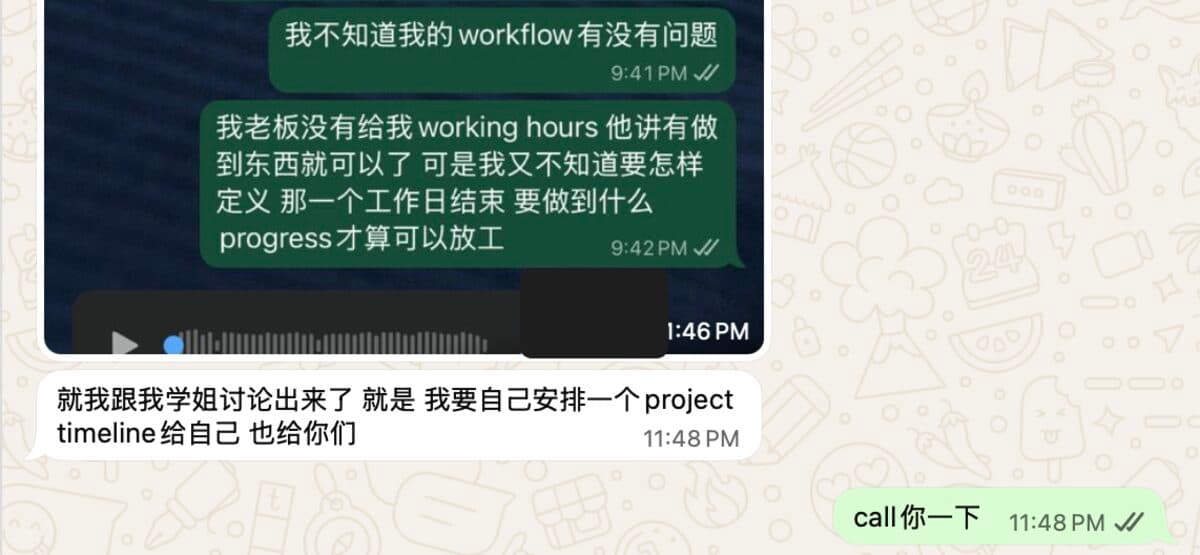 A late-night WhatsApp chat where a team member texts her university senior asking how to define a workday — because I never told her. I had a team member texting her university senior at 9pm, asking how corporate workdays are structured, trying to understand whether her workflow had problems. She wasn't complaining about me. She was just trying to find solid ground. And in the absence of anything I had given her, she reached for the nearest available footing.
The instinct, when you see this, is to close the gap with structure. Write the doc. Define the deliverables. Set the check-ins. And structure does help. But structure is not what she was actually missing.
What managing actually is
Managing, in the way most founders practice it, is a series of transactions. You assign work. You review output. You give feedback. You unblock. You repeat. It is necessary. It keeps things moving. But it is not sufficient, and most of us don't realize that until something breaks.
Managing tells someone what to do. It does not tell them how to think about what they're doing. It does not tell them why the standard is where it is. It does not tell them what you actually care about, underneath the tasks and the deadlines and the sprint reviews.
The result is a team that can execute but cannot navigate. They know what to build. They don't know how to make judgment calls when the brief is unclear. They can follow a process but they can't generate one. And when they're uncertain, they look outward for a reference point instead of inward, because there's nothing inward yet. You haven't put anything there.
Managing tells someone what to do. Transmitting gives them something to become.
What transmitting actually is
Think back to the person who most shaped how you work. Not the person who taught you a skill. The person who changed how you operate at a fundamental level. The one who raised your floor without sitting you down and explaining how they were doing it.
Chances are they didn't transmit anything through explanation. They transmitted it through proximity. You were close enough to watch how they thought. How they responded to setbacks. What they cared about when no one was checking. What they refused to compromise on even when compromise would have been easier. And something transferred, slowly, without either of you naming it.
That is transmitting. And it is the part of leadership that almost no one talks about because it doesn't look like leadership. It looks like just showing up and doing the work.
For me it was two people. A woman named Molly, who I watched hold a standard of care and precision in her work that I had never seen before.
 Molly and Jack Cooper during a recording session at Above Advisory's Sydney office. I was behind the camera. And my dad, who I watched carry boxes during COVID when the business was barely standing, when there was every excuse to lower the bar, and he didn't. Neither of them taught me anything directly. I just stood close enough, long enough, that I started to hold myself to something I couldn't have articulated at the time.
That's the thing most founders forget. They benefited from this. Someone gave it to them, intentionally or not. And then they build a team and focus entirely on the managing layer, leaving the transmission layer empty, wondering why their people don't operate with the same ownership, the same care, the same internal compass.
The abandonment nobody names
There is a version of leadership that looks generous but is actually a form of abandonment. It sounds like: "I trust you, just get things done." It sounds like: "We're a startup, we don't do rigid structures here." It sounds like: "I hire for autonomy, I don't want to micromanage."
All of that can be true and still leave someone completely alone.
Autonomy without context is not freedom. It is exposure. You are asking someone to navigate terrain without a map, and calling it trust. The junior hire who doesn't know how to define a good workday isn't failing to be autonomous. They are failing to have a reference point for what autonomous good looks like in this specific context, under this specific founder, building this specific thing.
That reference point is yours to give. Not through a document, though documents help. Through repeated, visible demonstration of how you think. What you prioritize when things are unclear. How you handle the moments that don't fit the process. What you mean when you say you care about the user. What it actually looks like when you hold a standard, not in a meeting, but in the small unremarkable moments of daily work.
If you haven't made that visible, you haven't given them a culture. You've given them a vacuum and called it freedom.
Why founders skip this
It's not laziness. Most founders who skip the transmission layer are not being careless. They're being efficient in the wrong dimension.
Transmission is slow. It doesn't produce anything you can point to in a sprint review. You can't put it in a Notion doc or check it off a list. It requires you to be legible, to show how you think rather than just what you've decided, and that's uncomfortable. It requires you to be present in a way that doesn't feel productive.
It also requires you to reckon with something most founders haven't fully examined: what is the standard you're actually trying to transmit? If you can't articulate what you care about and why, you can't pass it on. The transmission layer forces you to get clear on something that managing never does.
And there's a subtler trap underneath all of this. Some founders who want their team to have high standards, to care deeply, to operate with ownership, are actually looking for themselves in their team. They want someone who already has the thing they're trying to transmit. That's not development. That's casting. And when the junior hire inevitably moves differently than the founder would, the frustration that surfaces is not about output. It's about unmet projection.
Developing someone means meeting them where they are. It means understanding that the person in front of you came up differently, needs different things to build conviction, and will get there on a different timeline. Your job is not to compress their journey into yours. Your job is to give them enough proximity to something real that they start building their own standard, in their own way.
What to actually do
This is not a framework. Frameworks are managing tools. What follows is closer to a set of questions worth sitting with.
Have you told your team, not in a values document but in actual conversation, why you work the way you work? Not the mission statement version. The real version. What you're afraid of. What you refuse to compromise on. What keeps you going when the thing isn't working yet.
Are you visible in your thinking, or only in your decisions? There is a difference between telling someone what you've concluded and showing them how you got there. The former is a directive. The latter is transmission.
When your team member doesn't know what good looks like in an ambiguous situation, where do they look? If the answer is anywhere other than something you've modeled, the transmission layer is empty.
And the hardest question: do you know what you're trying to transmit? Not the values on the wall. The actual thing. The standard that lives in how you show up on a Tuesday afternoon when no one is watching and the work is hard and the easy thing would be to let it be good enough.
If you can't name it, you can't give it.
And if you don't give it, your team will find it somewhere else. Corporate. A senior they trust. A job description they found online. They will borrow the nearest available map, because people always do when they're lost.
The question is whether the map they find is yours.
Related: The Standard Setter — the Molly story in full. Where I first watched someone transmit a standard without ever teaching it.