On self
No Way Back
May 23, 2026 · 4 min read
没有路可退
I woke up at 6am and drove myself to a community run. I have asthma. I am built for sprints, not distance. I had not run 5km in longer than I care to admit.
I parked my car at the starting line. We ran along a main road. There was no shortcut back, no side street to slip down, no graceful exit. Halfway through, my lungs were burning and my legs were filing a formal complaint. I wanted to stop.
But I couldn't. The car was behind me. The road offered nothing but forward.
The car was at the starting line. There was no shortcut on that road. That was the moment I understood: you can cut off your own exit.
I didn't plan it that way. It was a coincidence. But coincidences teach the sharpest lessons, because you stumble into them without your guard up. What I discovered that morning was this: the absence of an exit is not a trap. It is a gift you can learn to give yourself.
Mental game
Running 5km is not a physical problem. Not really. The body can take more than the mind believes it can. Halfway through, when every instinct says stop, the real question is not whether your legs can carry you. It is whether you will let them.
I found a woman running ahead of me and made her my reference point. Not a competitor. Not someone to beat. Just a pacer: she runs, I don't stop. That small decision changed everything. Suddenly I wasn't fighting myself. I was just following.
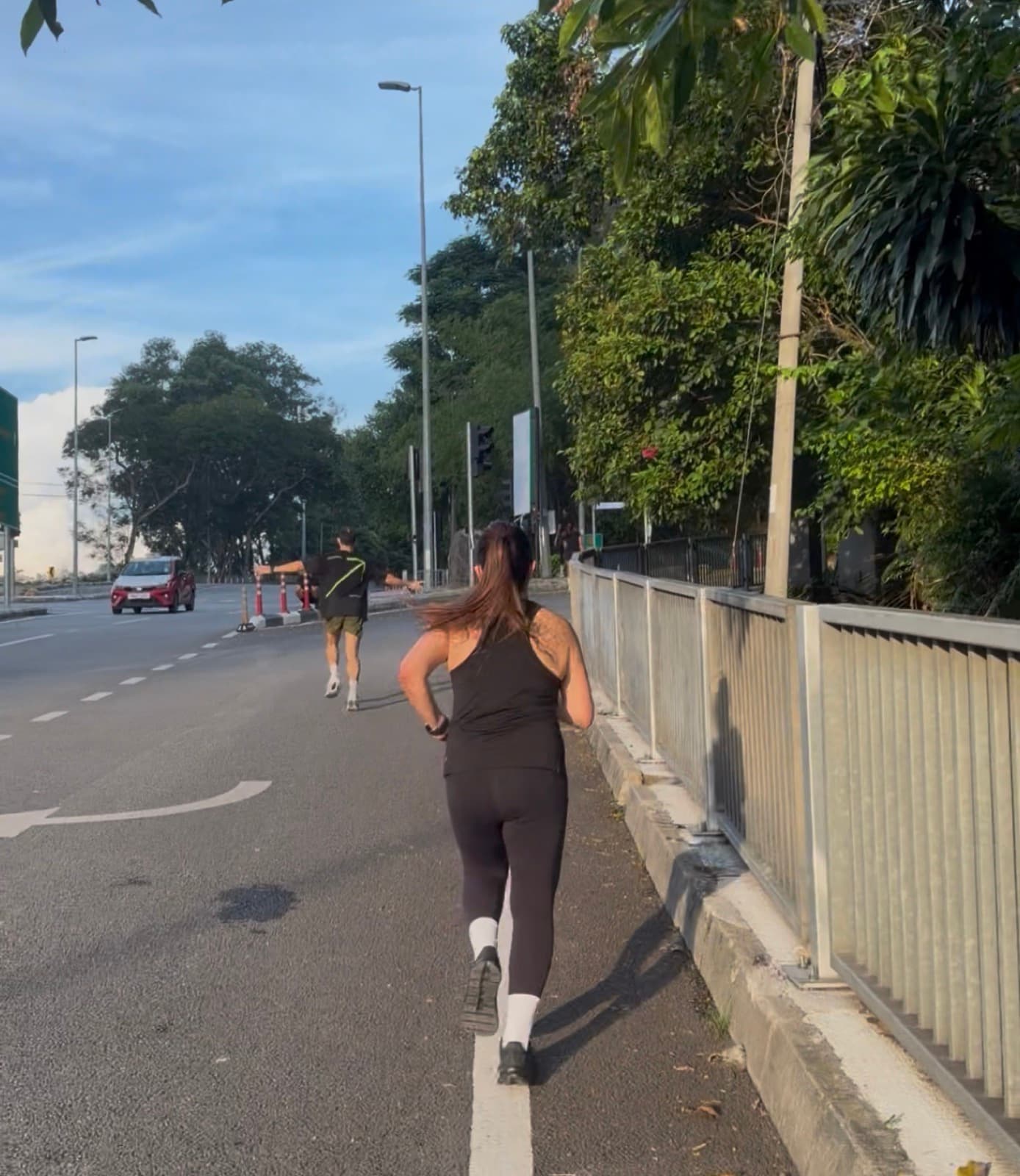 The pacer. She doesn't know it, but she carried me the second half of the run.
This is what separates people who finish from people who don't. Not talent. Not fitness. The willingness to keep the legs moving when the mind has already written the resignation letter.
那个骂你的人
A few years ago I was learning to drive manual. My instructor, an old uncle who had been teaching drivers for decades, was the kind of man who corrected mistakes by making you feel stupid for making them. He was good at his job. He was also relentless.
I wanted to quit and switch to automatic. It would have been easier. Nobody would have blamed me. Automatic is fine. Most people drive automatic.
But before I made the call, one question stopped me: why can others pass this, and I cannot?
Not in a bitter way. Genuinely. If other human beings, with the same two hands and two feet and one brain, can learn this, then the variable is not the task. The variable is me. Specifically, what I am willing to do to close the gap.
I stayed. I passed.
沉淀
What I didn't mention is the day in between. The day after the uncle's words landed, before I made the decision to stay.
I was not okay. Being told you are failing, repeatedly, by someone who has seen a hundred people do what you cannot yet do: it strips something from you. I felt small. I lost confidence in a way that felt physical, like something had been removed.
I spent that day asking myself questions. Not searching for comfort. Genuinely asking: what is true here? Is the uncle right that I cannot do this, or is he right only that I have not done it yet? What would it take? Am I willing to do that?
The answers came slowly. But they came from inside. Nobody handed them to me.
自信是自己给自己的
Self-belief is something you give yourself. Nobody will ever believe in you more than you are willing to believe in yourself.
This is the thing I understood in that quiet day of questions: the uncle's job was to teach me to drive. It was not to believe in me. That was never his responsibility. It was always mine.
Confidence that depends on other people confirming it is not confidence. It is approval. And approval is fragile, because it lives outside you, in the opinions of people who have their own bad days, their own biases, their own limits.
Real confidence lives inside. It is quieter. It does not need an audience. It just keeps asking: if others can do this, why not me? What is the right method? What have I not tried yet?
The person who tried to take your confidence is, in a strange way, the one who shows you where it actually lives. Because when it's taken from the outside, and you go looking for it and find it still there, somewhere in you, that is the day you stop needing anyone to give it back.
Founder, don't stop
Building a startup is a long run with asthma on a main road. There is no clean moment where it becomes easy. There are good stretches and brutal ones, and the brutal ones do not announce themselves in advance.
What I have learned, from running and from building, is one simple principle: you can rest, but you cannot stop. Slowing down costs you pace. Stopping costs you momentum, muscle memory, the rhythm your team has built, the trust you have accumulated. Restarting from zero is not the same as continuing from slow.
And the other thing: learn to cut off your own exits. Not recklessly. But deliberately. Put yourself in situations where quitting requires more effort than continuing. Park your car at the starting line. Sign the contract before you feel fully ready. Make the commitment public before the fear has time to negotiate.
The no-exit is not a trap. It is the kindest thing you can do for the version of yourself who will want to quit at the halfway point.