On self
Why I Chose Accounting and Finance
May 19, 2026 · 5 min read
The thing I didn't have
I was not born with the easy version.
Not the looks. Not the natural charm that makes people gravitate toward you before you've said a word. Growing up, I was often overlooked. Not always disliked, just not the person people immediately rooted for. You know the type they root for. I wasn't it.
For a long time, that stung. But eventually, it taught me something that I think is the most important thing I know:
用绝对的实力战胜一切。
Win with absolute capability. Because capability is the one thing nobody can take from you, and nobody can fake.
Everything I've done since, every decision, every door I knocked on, every degree I chose, traces back to that belief.
Eighteen
Most people who say they "ran a social media account in high school" mean they posted a few times and got some likes.
That's not what I did.
At 18, I built a media business. It started as a learning account. I published study notes for the 独中统考, the Chinese independent school exam. But I quickly realised that content alone wasn't the point. The point was the audience. I had built something rare: a niche, highly targeted audience of Malaysian Chinese secondary school students. Every single follower was exactly who the right advertisers would pay to reach.
So I started connecting dots.
Teachers had content but needed students. I had students but needed content. I organised 15 public classes, they taught for free, and they got to recruit tuition students from my audience. Nobody paid anybody. Value moved both ways.
Note-takers had material but no distribution. I had distribution but needed material. We split the revenue from every set of notes sold. I also repurposed their content into carousels for my feed.
University placement agencies had money but couldn't find their exact customer. I had their exact customer. They bought ad slots. I ran giveaways. The giveaways collected emails and phone numbers, first-party data, before anyone called it that.
Three revenue streams. Zero upfront capital. No rich parents needed.
That was my marketing degree.
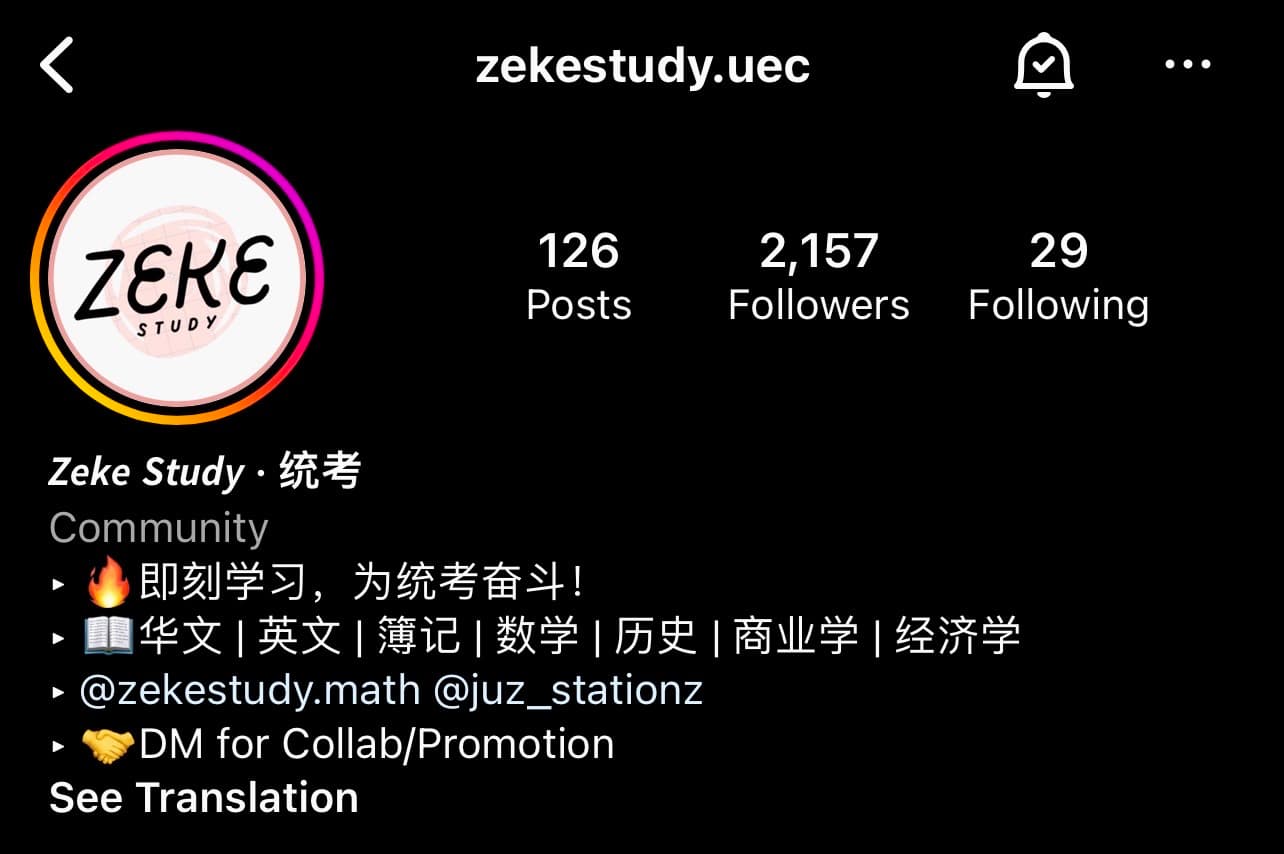 Zeke Study · 统考 — the account I built at 18. 126 posts, 2,157 followers, covering every major 统考 subject.
What I already knew
By the time I sat down to choose my university major, I had already answered the question most people go to university to answer: can I build something?
I knew I could. I had proof.
I also knew something about the marketing industry that most 18-year-olds don't: nobody cares about your certificate. They want to see your numbers. How many leads? What was the conversion rate? What did you actually build? Your past work speaks louder than your paper.
Most people choose their degree hoping it will teach them how to build something. I chose mine because I already had, and I knew what was missing.
What was missing was the technical language. The inside of a business, not just the outside. I understood how to bring attention and revenue in. I didn't yet understand what happened to it once it arrived.
That's why I chose Accounting and Finance.
The language of business
Accounting is backward-looking. It tells you what happened: where the money came from, where it went, whether the business is actually healthy or just looks healthy. It's the language of truth inside a company.
Finance is forward-looking. It's how you think about growth, capital, cash flow, risk. It's how you make decisions about what comes next.
I didn't choose this because I wanted to become an accountant. I knew very clearly, from my first week doing bank reconciliation work in my family's business, that I did not want to spend my life doing repetitive admin. That was never the plan.
The plan was to have both sides. To understand the numbers and understand the customer. To read a financial statement and know how to grow the top line. To speak the language of the CFO and the language of the market.
Because in the real business world, one side alone is not enough.
The door
When I was working at my family's company before university, I was assigned bookkeeping tasks. Manual reconciliation. Repetitive. Administrative.
I did it for a while. Then I stopped.
I walked to the CEO's office and knocked on the door.
"Tell me what the company is actually struggling with. Tell me the real problems. I'll think of solutions."
I was 18. I had just finished secondary school. He looked at me and asked if I was sure, if I understood what I was asking for, the pressure that came with it.
I was afraid. Of course I was afraid. But I had already learned something by then: waiting is the most expensive thing you can do with your time. Nobody hands you the interesting work. You have to go ask for it.
He gave me a chance. That conversation shaped more of how I think than almost anything I studied in a classroom.
The same logic, bigger stage
Here's the pattern, when I look back at everything:
At 18, I saw that teachers had content and needed students. I had students and needed content. I connected them.
I saw that note-takers had material and needed distribution. I had distribution and needed material. I connected them.
I saw that advertisers had budget and needed a specific audience. I had that audience. I connected them.
Today, I'm building Dodeez. The logic is the same. See who has what. See who needs what. Build the thing in the middle that makes both sides better off.
The degree gave me the language to understand the inside of a business. The years before it gave me the instinct to see the gap. The belief I built as a kid who had to earn everything, that gave me the discipline to actually move.
The real reason
So why did I choose Accounting and Finance?
Not because I wanted to become an accountant. Not because my family expected it. Not because it was safe.
Because I had already learned the part most people go to university to learn. And I was honest enough with myself to know what I still didn't have.
That kind of honesty, about where you're weak, about what you're missing, about what you still need to earn, that's the thing I'd tell anyone to develop.
Not confidence. Not a plan. Just an honest inventory of what you have, and the discipline to go get what you don't.
The rest follows.