On building
They Weren't Rejecting Software. They Were Rejecting Uncertainty.
May 20, 2026 · 5 min read
The Stamp
I needed a company stamp.
In Malaysia, you can't open a business bank account without one. So I walked into a stamp maker near my area, placed the order, and waited. While I waited, I looked at their website on my phone.
It was bad. Outdated layout, no clear pricing, no way to order online. A business that had been running for over thirty years, serving customers who needed chops and seals every day, with a digital presence that looked like it was built in 2008 and never touched again.
I sat down at the cafe next to the store and built them a demo website. Fifteen minutes later, I walked back in to collect the stamp. I asked the front desk if I could speak to someone in management. She brought me to the executive.
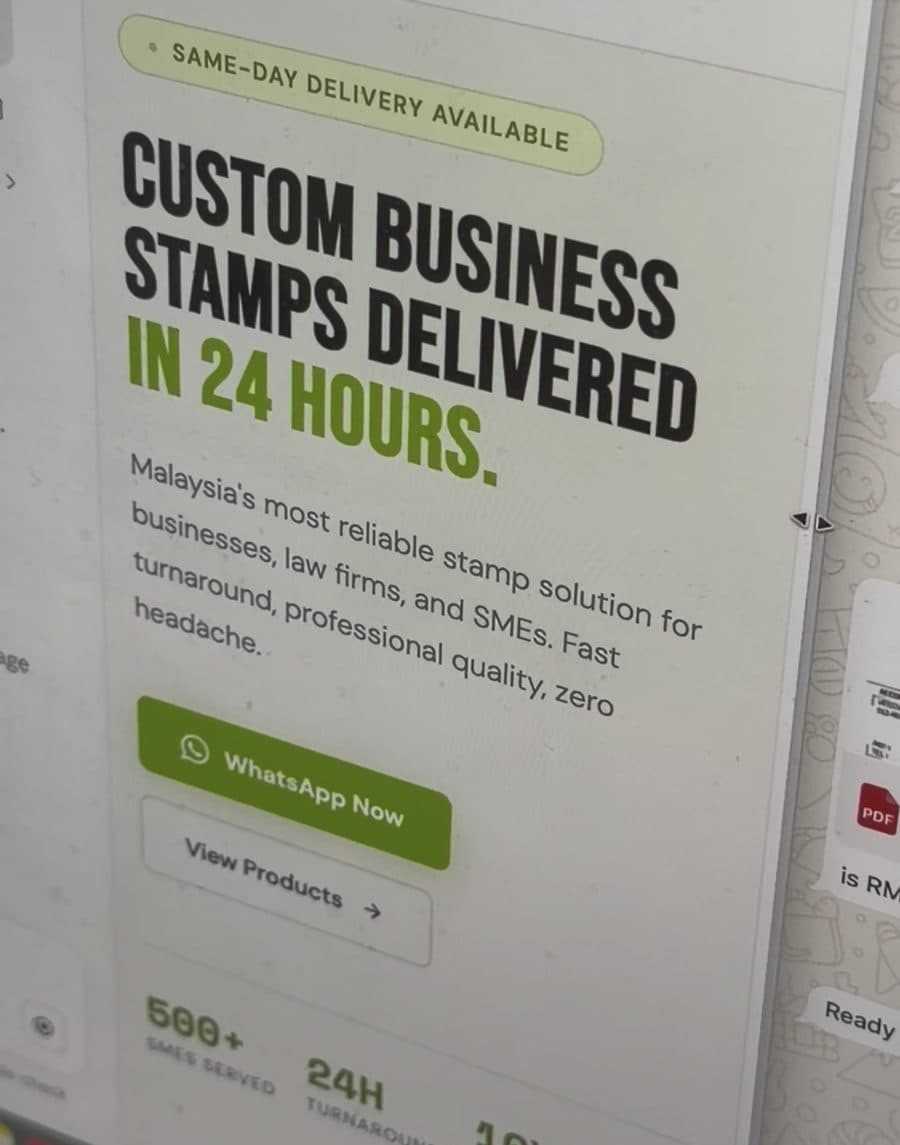 The demo website. Built at the cafe next door, fifteen minutes before I walked back in.
That was the first meeting.
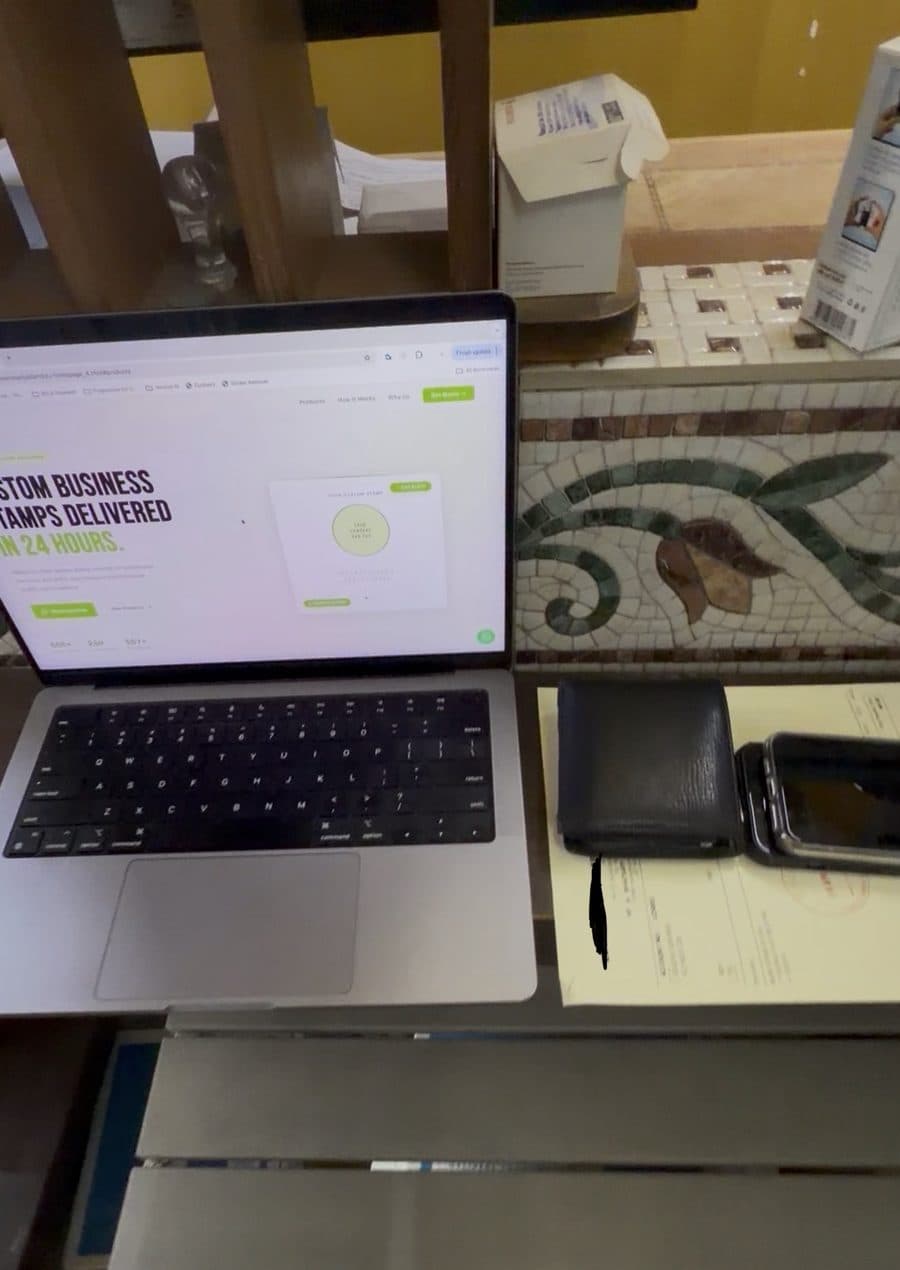 The demo on screen. The stamp beside it. Their inventory behind. This was the moment.
The Proposal
I showed him the demo. He was receptive. We talked about what else could be done.
So I came back with everything.
A new website. An online checkout and payment system. An inventory management system to replace the handwritten records. Workflow automation. And an AI Agent connected to WhatsApp, so customers could check order status without calling in.
I was proud of that proposal. It was thorough. It covered every gap I had spotted.
What I didn't fully see then was that I had just shown a thirty-year-old company the gap between where they stood and where I wanted to take them. And that gap was enormous.
What He Actually Said
The executive was honest with me. More honest than I deserved.
He told me there were a lot of documents. A lot of inventory to account for. And that he thought it would be hard for the staff to adapt.
He handed me the answer. I just wasn't listening carefully enough at the time.
He wasn't telling me the product was bad. He was telling me that the distance between his current reality and my proposal felt uncrossable. Handwritten records on one end. AI Agents on the other. And nothing in between to show him how to get there without everything falling apart.
A few days later, the message came.
"The company isn't ready to digitalize at this point."
The Real Rejection
There's a version of rejection that's about the product. The features aren't right, the price is off, someone else did it better.
This wasn't that.
They weren't rejecting software. They were rejecting uncertainty. The uncertainty of what happens to thirty years of handwritten records during migration. The uncertainty of whether older staff can learn a new system. The uncertainty of what a week of disruption costs a business that runs on tight margins and tight routines.
Paper feels safe. Manual work feels controllable. When you've run things the same way for three decades and nothing has collapsed, change doesn't feel like progress. It feels like risk.
I walked in thinking my job was to sell a product. Their job, without knowing it, was to protect everything they'd built from something they didn't fully understand yet.
The Chain Nobody Talks About
Everyone talks about AI. Very few people talk about what has to come before it.
Before AI, you need clean data. Before clean data, you need structured digital workflows. Before digital workflows, you need people willing to change how they work. Before people willing to change, you need them to feel safe enough to try.
Most software salespeople show up at step four and wonder why nobody's moving.
I did the same thing. I skipped straight to the destination and forgot to show anyone the road.
The real bottleneck in Malaysian SMEs isn't technology. The hardware exists. The software exists. Affordable, accessible, well-built tools exist. The bottleneck is the distance between where a business is and where you're asking them to go, and whether they believe someone will walk with them through it rather than just hand them a system and disappear.
What I'd Do Differently
I wouldn't start with a proposal.
I'd start with a question. Not "here's what we can build for you" but "do you actually want to change how you operate?" Because taking a meeting and wanting to transform your business are two completely different things. I assumed the desire was there because the executive showed up. That was my mistake.
Before showing anyone a product, I need to understand where they are on that journey. Are they curious, or are they just being polite? Do they feel the pain of staying the same, or is the pain of changing still larger?
If the desire isn't there, the roadmap doesn't matter. They'll nod in the meeting and go back to paper the next morning.
And if the desire is there, Week 1 shouldn't have a single deliverable. No SOPs, no documentation, no system setup. Just sitting with the team. Watching how they actually work. Asking questions with genuine curiosity. Making the staff feel like you're there to make their lives easier, not to complicate them.
Trust comes before transformation. Every time.
The Door I Left Open
I replied to the message the same evening.
Told him there was no pressure. That every business has its own timing. That when they were ready, we'd still be here. And that the demo website was theirs to use for as long as they needed it, no strings attached.
I meant all of it.
This particular conversation didn't convert. But it taught me more about the market than a successful sale might have. I know now what the fear actually looks like when it's sitting across the table from me. I know what questions to ask before I open any deck. I know that the product is rarely the problem.
Some conversations are sales. Some are market research. This one was both.
The stamp is on my desk. The door is still open.